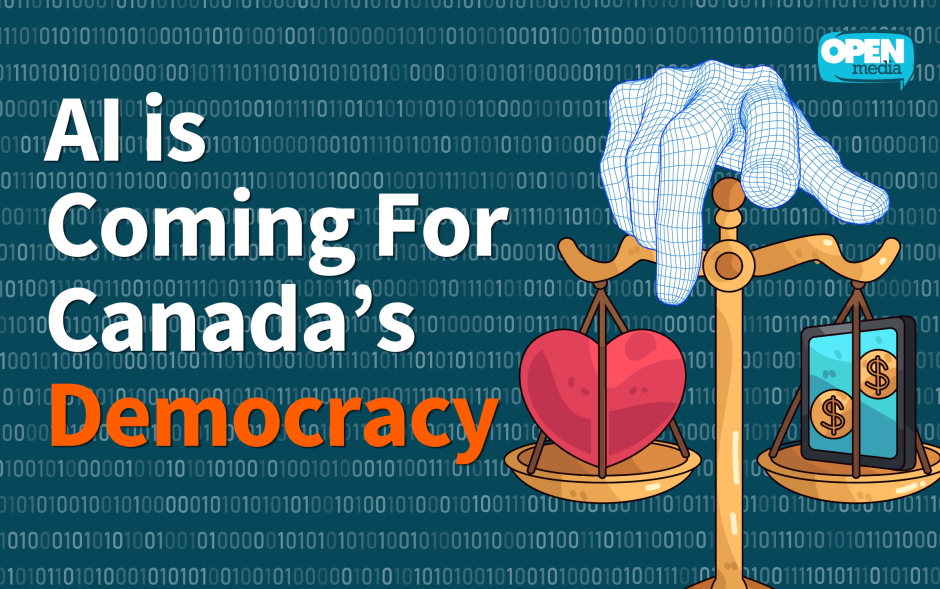

AI is Coming for Canada’s Democracy
OpenMedia's Executive Director Matt Hatfield testified at the Senate on what AI means for Canadian democracy.
On April 15, 2026, OpenMedia's Executive Director Matt Hatfield appeared before the Senate Standing Committee on Transport and Communications to speak about the opportunities and challenges of artificial intelligence (AI) in the information and communications technology sector.
His message was simple: if Canada doesn't act now, AI will quietly hollow out the systems that make our democracy work.
The human presence on the Internet is shrinking. A study by SEO firm Graphite found that 52% of all new written content published between 2020 and 2025 was AI-generated. As AI agents become more capable and affordable, they are increasingly being deployed to act on behalf of humans online — often indistinguishably so, with more bots talking to bots than ever before.
When AI can generate thousands of convincing comments, flood public consultations with fake input, or make it nearly impossible to tell real news from fabricated stories, the foundations of democratic participation start to crack.
Hatfield pointed to a recent example close to home: the federal government's 30-Day National Sprint on AI Strategy in 2025. The consultation received 11,300 responses, but there was no way to verify whether those responses came from real Canadians. Participants weren't required to provide any identifying details to participate — no names, no emails, no Canadian address. And to make things more complicated, the government used AI tools to summarize and process all that feedback. How can we trust public consultations if we can't confirm humans are participating in them — on either side?
The problem goes even deeper. AI is becoming sophisticated enough to find loopholes in laws and regulations — exploiting gaps that were never meant to exist. And it can generate a flood of believable false content, making it harder for voters and governments to tell what's real, and what isn't.
To protect Canada's democracy, OpenMedia put forward four recommendations:
- A trustworthy tool for public participation. Canada needs a civic engagement platform that confirms users are real Canadian residents — without collecting personal data — and makes it easy for people to find and participate in government consultations. Government would get a secure, tamper-proof record of how the public responded to its consultations and initiatives.
- An authentication system for fact-based journalism. In the age of credible-looking AI flooding the Internet, we need an easy way of judging whether information comes from a credible source. Canadian news organizations, libraries, and platforms need a way to cryptographically verify that their content came from a known, accountable source and hasn't been altered — a way of marking content that functions like a postmark and seal of authenticity combined. This is not about government approval of content, but about establishing a verifiable chain of custody and origin source for judging the trustworthiness of content that fills our feeds.
- Algorithmic transparency legislation. Right now, the algorithms that decide what we see online are designed to keep us scrolling — through outrage, entertainment, and everything in between. Canadians deserve laws that require platforms to explain how those algorithms work, and give us a real choice in how our news and information feeds are shaped.
- Serious reform of public data handling and transparency. The government must commit to publishing clear public data in easy to use formats, and thoroughly reforming our access to information system. Historically, governments have sometimes benefited from keeping public data hard to access, delayed, or incomplete — it made inconvenient truths harder to notice. But in an AI era, that calculus has flipped: when official government information lacks credibility, AI-generated disinformation that appears more complete and more honest will rapidly fill the void.
A version of the Internet dominated by bots and synthetic content is coming fast — that's already underway. But it doesn't have to mean the end of meaningful democratic participation. Canada can still build digital systems that keep real people at the center — if we start now.
To learn more, the recording and full text of our testimony are available here.


 Take action now!
 Sign up to be in the loop
 Donate to support our work